
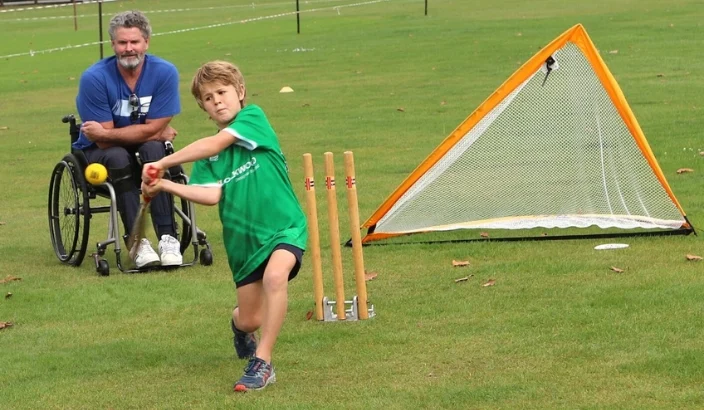
A collaboration between two Marlborough-born sportsmen in a world first, could revolutionise the way junior cricketers learn to play the game.
Former Black Caps allrounder Chris Cairns and long-serving coach Garry MacDonald have joined forces to come up with a new introductory game for budding cricket players, aged six to nine.
Now, after reviewing experimental games on both sides of the Whangamoas earlier this year, Top of the South administrators have agreed to trial the new concept during the forthcoming season.
It will be part of the Nelson Cricket Association’s junior programme from the opening of the season.
'Machine Ball Cricket’ [MBC], as it has been tagged, was originally Chris’s brainchild, based on his observations of how young baseballers were taught the rudimentary skills of that game.
“We adapted MBC from baseball. They have been doing this for quite some time. My kids played baseball in Australia and I thought that it was a great way to get more balls in play for junior cricket as well,” enthuses Chris.
“They don’t ask their kids to pitch at this age so I thought why should we expect kids to bowl at this level of cricket, bowling consistently is really hard for them.”
In a nutshell, MBC is played on a circular arena, with three designated hitting “Max” zones. Fielders stand on plates marked with the relevant fielding positions, for both left and right-handers, and rotate at the end of an over. There are two batsmen, who run between wickets and bat for two, eight ball overs, per pair.
The primary innovation is a spring-loaded pitching/bowling machine, as used in junior baseball. It is operated by a coach/parent, and produces reliably accurate deliveries, with the ability to alter trajectory, speed and length.
Chris says the biggest plus is that the batsmen are getting so many more balls to score off, thus bringing the fielders more into the game.
“There are now no wides [with MBC] whereas with this age group at the moment there are at least three to four wides per over,” he says.
“At this stage it is far from the finished game, it is just experimental to see how we go and how the kids adapt to it.”
“I said to Mac, let’s have a think about it and at this stage that is where we are at.”
Garry says he is excited by the game’s possibilities.
“I haven’t coached kids of this age for about 40 years so I had to concentrate on what Chris was saying. But once I thought about it, I thought ‘hey, this makes perfect sense to me’.
“So I said, let’s adapt a game in the Top of the South where we can be first. We can invent a game which we think will make our kids better.”
“While they are hitting the ball, and there is a lot of activity with the ball in play more often, you are able to teach them field placings, how to back up properly, running between wickets, all those little skills . This is the group where they can learn those basics, they are like sponges at this age,” adds Garry.
“At the moment, the game involving this six to nine age group is dependent on the quality of bowling, so now we have taken that out the question is, ‘can we provide a better game for the kids?’ and we think we can.”
The elephant in the room, of course, is the question, “what about the bowlers, how do they learn their skill?”.
“We want to have a bowling technique focus for ages six to nine. The kids will still be bowling at home, at school and at the park, they just won’t be bowling 16 balls on a Saturday. If they bowl 150 times in a week now, does bowling 134 times in a week now change things, I don’t think so,” explains Chris.
