
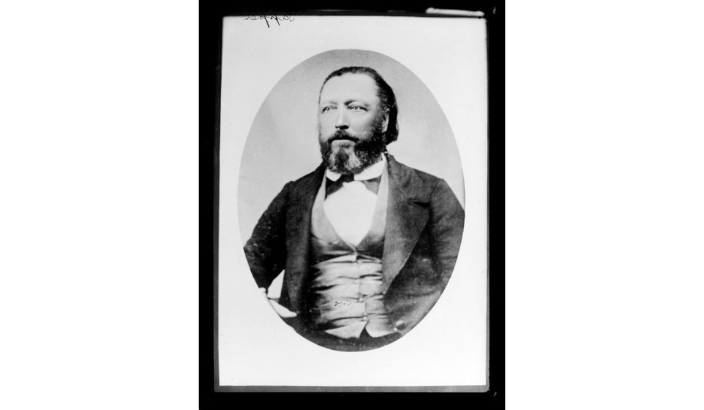
When Bernard Gapper stepped ashore in Nelson in 1842, he was part of a new settlement whose future seemed full of promise.
He sailed from England aboard the Clifford as the ship’s assistant surgeon and had come to New Zealand under the Wakefield and New Zealand Company settlement scheme.
Bernard was accompanied by his wife Mary, and together they had 10 children. Sadly, several of their children died at a very young age. Mary, who was born in Somerset in 1801, was the daughter of Samuel and Mary Dalley.
The Gappers were among the settlers recruited under the New Zealand Company’s ambitious plan to establish new communities in New Zealand. The company organised an expedition to establish the Nelson settlement in 1841. The first ships, Whitby and Will Watch, carried the men who would help establish the settlement, while the Arrow transported supplies.
The scheme promised much. Labourers and tradesmen were offered free or assisted passages for themselves and their families, guaranteed employment on arrival, wages, and the prospect of eventually owning land. For families such as the Gappers, it offered hope of a better future in a new land.
However, the reality proved very different. By 1843, the New Zealand Company was facing financial ruin. It struggled with heavy debts, disputes over land titles, absentee landlords, a lack of capital, unemployment, limited land and growing dissatisfaction among settlers. Many who had left England with hopes of success soon found themselves facing hardship and uncertainty.
Bernard was among those called to serve the new settlement. In 1843, he was drafted into the constabulary force sent to the Wairau, where he was present during the Wairau Affray. During the confrontation he was wounded in the hand and later received medical treatment in Wellington.
After returning to Nelson, Bernard spent several years working as a storekeeper. His experience and abilities eventually led to his appointment as second officer of Her Majesty’s Customs under Mr Logie in Nelson. He also worked as a landing waiter, a customs officer responsible for supervising the unloading of cargo from ships, checking manifests, weighing and measuring goods, collecting duties and helping prevent smuggling.
His health was not always good, however, and heart problems eventually forced him to resign from his customs position in late 1854. He then moved to his farm at Appleby, which he named Axe Farm.
Education was another important interest in Bernard’s life. Keen to see local children receive a proper education, he was elected to the Local Committee of Education in 1857. Three years later, he was dismissed along with William McRae and E. Humphries after being absent without leave from three consecutive meetings.
Bernard returned to public service in July 1863 when he was re-elected to the board as Richmond’s representative on the Central Board of Education.
Bernard died at Axe Farm in late August 1869 and was buried in the churchyard at St Alban’s.
Mary remained at Appleby for many years after her husband’s death. She died on 13 December 1892, aged 92, and was buried beside Bernard at St Alban’s Cemetery.
Together, Bernard and Mary Gapper belonged to the generation of early settlers who arrived in Nelson hoping to build a new life.
