
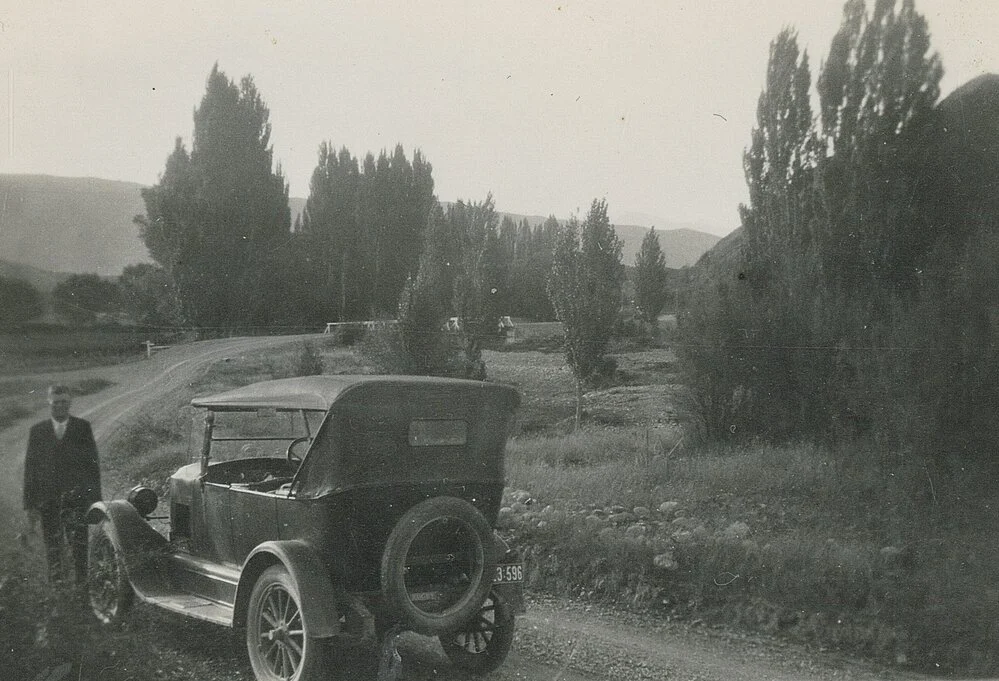
The construction of the Spooners Range road made travel easier between Nelson and Motueka, but it also brought its share of challenges, mishaps and near disasters.
In 1882, major works were undertaken to construct a two-mile Spooners Range diversion for a new road from the top of Spooners into Norris Gully. The new route was slightly longer than the original road but provided easier gradients.
Messrs Granger and Mead, of Foxhill, won the tender for the work at a cost of £712. The road was later metalled in 1885.
People were tough in those days and thought little of the effort required to get from place to place. In late 1886, a rider encountered a family from Waimea walking and pushing their baby in a pram up the steep track to visit friends in the Motueka Valley. They were determined not to let any obstacle stand in their way, including a gravel road crossing a 1470-foot-high hill.
As use of the road increased, accidents became inevitable and Spooners Range claimed its share.
In February 1887, the Greymouth and Buller coach, carrying 11 passengers, was involved in a potentially serious accident. Driver Otto Haase was descending Spooners when one of the swingletrees, a small wooden or metal bar behind a harnessed horse, became detached and frightened the lead horse.
Otto had the foresight to steer the coach into a bank, preventing it from plunging into the gully. Although the coach capsized and passengers were thrown onto the road, none were injured.
In February 1924, a Newman Bros mail and passenger car was travelling to Nelson when smoke from a scrub fire was spotted in the gully below while ascending Spooners. Although a strong wind was blowing, it was initially believed there was no danger.
As the vehicle approached Windy Point, flames were blown across the road and thick smoke reduced visibility to almost nothing. The car caught fire and was destroyed, along with seven bags of mail. All passengers escaped injury.
Two years later, in April 1926, the Winn family were travelling down the Kohatu side of Spooners when the brakes failed.
Winn had been driving cautiously downhill with the ignition switched off and the vehicle in top gear, but it soon accelerated to about 40mph, or 64kmh. While that speed may seem modest today, the road was unsealed, steep and lined with sharp hairpin bends.
Winn eventually steered the vehicle into a bank, overturning it. Despite the crash, everyone escaped serious injury.
Like today, the range was vulnerable to severe weather. The road was often flooded or blocked by slips, making it impassable.
In 1930, the Main Highways Board undertook further improvements, reporting that the road surface had settled and "held no terrors even for the most timid of drivers". Corners were well banked, some had been widened and, in places, vehicles could safely pass one another.
Another serious incident occurred the following year when Mr H. Curtis, driving a borrowed five-seater touring car, ran off the road in thick fog and plunged down a bank.
With fuel running low and the vehicle unable to start on the slope, Curtis walked to Foxhill to obtain more petrol. When he returned, some fuel was poured directly into the carburettor to help start the engine. While warming the vehicle up, the engine caught fire and quickly engulfed it in flames.
Exactly when Spooners Range was finally sealed remains uncertain. However, in 2003 the route underwent major realignment work, involving land acquisition and boundary changes to improve the highway.
Whether any part of the original road remains today is not known.
