
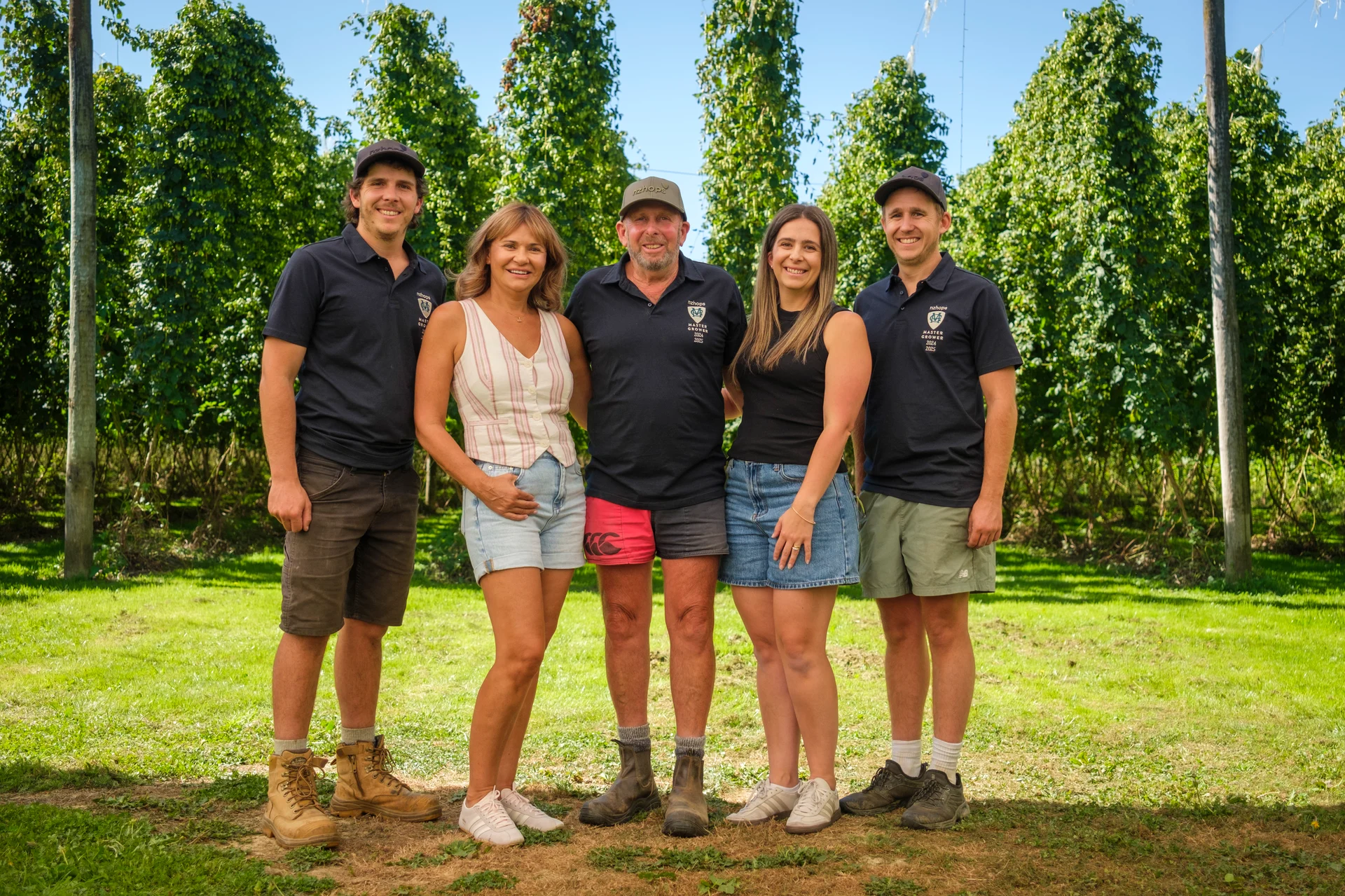
New Hoplands farm has been growing hops organically since the late 1980s, utilising the Tapawera climate to cultivate a diverse range of high-quality New Zealand hops.
Owner Colin Oldham started organic production on part of his property after seeing the heavy chemical reliance in overseas hop farming.
According to his son Hayden Oldham, who manages New Hoplands with his brother Thomas, Colin realised New Zealand’s natural growing conditions were already close to organic by comparison, making it an ideal fit for their Tadmor Valley Road property.
“The biggest challenge in organic farming is weed control, which requires extensive hand-weeding until the hop plants grow large enough to outcompete the weeds,” Hayden explains.
“Sourcing certified organic nitrogen and natural fertilisers is another key challenge.”
The Oldham’s farm has had success in organic hop cultivation, including a notable visit, back in 2001, from the Busch family of America’s Budweiser Beer.
The fourth-generation farm has been in the Oldham family for more than 75 years, starting with Hayden’s great grandad in the 1950s.
It originally began as a tobacco farm and has hosted livestock, including sheep and ostriches over the years.
“Because the growing and processing methods for hops were similar to tobacco, it was a smooth transition,” Hayden says.
The Oldham’s farm is now 52 hectares, based in Tapawera, while the family also leases a further 24 hectares in Ngātīmoti, near the Motueka River.
New Hoplands’ organic gardens take up 10 hectares of their property, with Superdelic one of the most popular varieties, featuring red fruit, candy, citrus and tropical fruit characteristics.
In total, New Hoplands produces 24 varieties of hops across its organic and conventional gardens.
The machinery and equipment at New Hoplands were largely made by a local engineering firm Hop To It, which one of the family worked for at the time.
“Some large components were shipped in from United States and were customised to fit into how we had decided to layout the machine,” Hayden explains.
“For the most part the machine is just a rejig of tried and tested components with a few of our own creations added in.”
The main growing stages throughout the year are after harvest and start in April and May with garden maintenance, around June there is weed control and in August, New Hoplands begins stringing.
In July, the team lifts nursery plants, raised through the 2025–26 growing season, with a potato digger.
The plants are cleaned, binned, and stored in the cool store until early spring planting.
In September, New Hoplands plants any hops it may be changing around, while the hops are trained to climb up the strings in October and November.
Harvest begins in late February and then the cycle repeats with a lot of other jobs in-between.
New Hoplands’ hops mostly go into beer products, brewed all over the world, however they are also used in health products, including Calocurb a weight loss supplement.
Everything New Hoplands grows is sold through the New Zealand Hops Co-op, which distributes it to domestic and international markets.
“Our core mission today is to grow and supply the cleanest, highest quality hops possible,” Hayden says.
And it’s not just the farm that’s contributing to the growth of the hop industry.
Colin’s wife, Alana, is a board member of NZ Hops Limited.
In 2009, she created a natural skincare range using the oils and minerals from hops plants, called Oxygen Skincare, before selling the business in 2019.
